


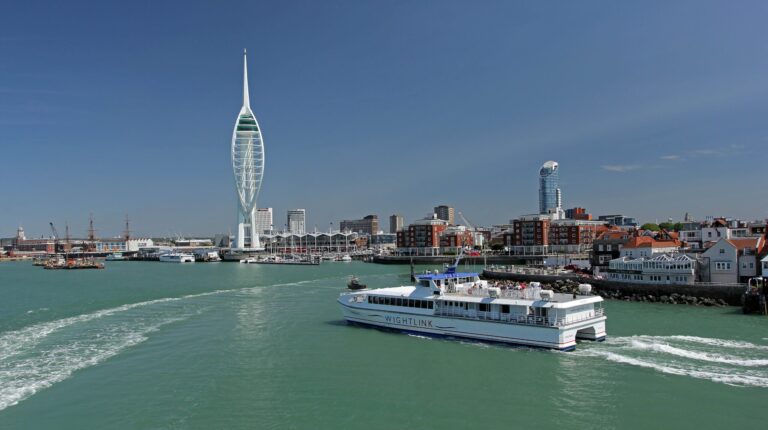
Southampton Solent University has joined a project funded by the UK government and led by Wightlink to assess how zero-emission operations could be introduced on the operator’s high-speed FastCat ferry service.
The seven-month feasibility study has secured funding from the government’s Clean Maritime Demonstration Competition (CMDC6) and will explore how renewable shore power could replace diesel while FastCat vessels on the Portsmouth–Ryde route are docked.
The project will examine how renewable energy generation and energy storage systems could supply onboard power when vessels are alongside, eliminating the need to run diesel engines in port. According to the project partners, the approach could reduce greenhouse gas emissions, improve local air quality and provide a model for cleaner short sea ferry operations.
The study will model vessel energy requirements, assess renewable infrastructure options and develop a regulator-informed roadmap toward future zero-emission operations. Infrastructure readiness at Gunwharf Quays and Ryde Pier will also be evaluated.
“Using our state-of-the-art full mission bridge and engine room simulators, we will model vessel operations, emissions and shore-side energy integration under real-world conditions,” said Capt. Zakirul Bhuiyan, associate professor of maritime simulation and autonomy at Southampton Solent University. “This feasibility study will validate renewable solutions to replace in-port diesel use, supporting technical readiness and accelerating the wider transition to zero-emission ferry operations.”
The project is being delivered by a consortium led by Wightlink and M3MAS Limited, with support from Ameresco, Southampton Solent University and Supply Chain Analysis. It will assess power supply options including grid connections, solar generation and battery storage, alongside cost projections and emissions impact analysis.
Wightlink said eliminating diesel use while vessels are alongside could have a measurable environmental impact. “By eliminating diesel use while our FastCat vessels are alongside, we can significantly improve air quality in Portsmouth and Ryde and reduce greenhouse gas emissions,” said Charles Field, head of engineering and estates at Wightlink.
If implemented, the shore power solution could save an estimated 96 metric tons of CO2e per year, equivalent to removing more than 40 passenger cars from the road. The project partners say the modular approach could be replicated across more than 80 short sea ferry routes in the UK and support compliance with future emissions regulations, including the EU’s FuelEU Maritime framework.
In related news, Royal Bodewes to build zero-emission electric cargo vessel for K Sætre Rederi