


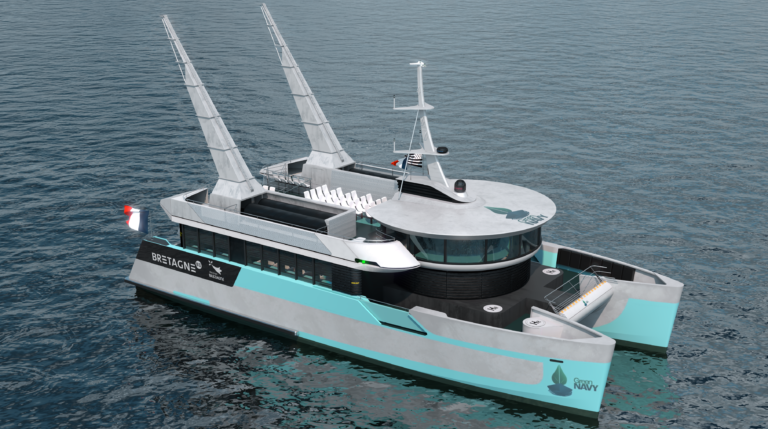
After launching for the off-highway and special vehicle markets in May 2025, the Kinell Group has now added marine decarbonization activities to its offering. The move is designed to consolidate all decarbonization activities under a single international brand across off-highway machines, special vehicles, the professional marine sector, site energy and digital services.
The Fetis Group (a privately owned engineering group) has its headquarters on the banks of the Loire in Nantes. In the last 10 years, the group’s Seco Marine division has executed an increasing number of decarbonization projects, through electrification and hydrogen propulsion and onboard power. These systems integration projects have been on new vessels and retrofits. This capability will now fall under the Kinell name.
“By bringing our marine systems integrations activities into the Kinell brand into the marine sector, we see great opportunities for technology transfer between the land-based and water-based activities,” said Damien Fétis, president of Fetis Group.
“Additionally, in some projects we envisage a whole ecosystem approach to decarbonization with port equipment or energy storage enabling and reinforcing the decarbonization of vessels. At the same time, we know it is critical to have an experienced and dedicated team who really understand the regulatory environment and needs of the actors in the marine value chain. This kind of expertise means that the customer can be confident in our ability to execute projects successfully, on time and on budget.”
Kinell’s portfolio covers all aspects of the onboard energy chain, including: ship electrification; motorization and propulsion; safety (particularly in relation to hydrogen and new energy carriers); programming/software (control-command, energy management); hydrogen integration (tanks, fuel cells, piping, control software and so on); and hybridization with combustion engines (customized generators, hybrid solutions and more).
In an industry subject to rapidly changing standards, Kinell has noted that stakeholders (including fleet managers and shipowners, shipyards and integrators, public organizations and regulatory bodies) are increasingly seeking guidance on how to define an energy architecture and how to choose and integrate the right technologies, as well as advice on securing projects and structuring the energy transition of their fleets.
“Shipowners, shipyards and public authorities are no longer just looking for components, they are looking for a partner capable of taking charge of the entire energy chain on board,” noted David Bartoletti, general manager for the marine sector at Kinell. “At Kinell, we are perfectly positioned as one of the few integrators capable of covering all these areas – from electrification to hydrogen – and supporting our customers in France and Europe over the long term.”
Kinell can support projects from the initial planning stages through to operational implementation, including design of carbon-free propulsion systems, studies for the creation of new ships or the retrofitting of existing ships, and definition of overall energy architectures. Kinell also provides dedicated technological building blocks that can be integrated into new or existing projects.
“Our strength lies in our ability to speak the language of both engineers and operators, added Bartoletti. “We design complete energy architectures, develop our own energy management software and integrate the best technologies available on the market. Kinell for the marine industry has the ability to bring all these elements together to deliver carbon-free propulsion systems that are truly adapted to the constraints of the field.”
Related news, Royal Bodewes to build zero-emission electric cargo vessel for K Sætre Rederi