


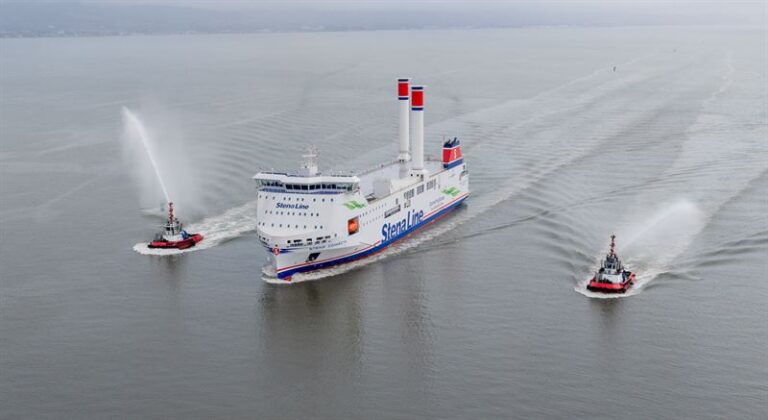
Stena Line’s latest hybrid-capable freight vessel, Stena Connecta, has arrived at Belfast Harbour and is scheduled to enter commercial service on the Belfast-Heysham route today, January 23, 2026.
The vessel joins sister ship Stena Futura, which entered service on the same route in October 2025. Together, the two ships will increase freight capacity on the Belfast-Heysham service by around 40%, responding to rising demand on the Irish Sea corridor.
Stena Connecta is a purpose-built New Max ro-ro freight vessel with 2,848 lane meters of capacity across its 147-meter length. Like Stena Futura, it is equipped with a multihybrid propulsion system that enables operation using battery power and is designed for the use of biofuel and methanol.
In addition to its hybrid electric capability, Stena Connecta features two 28m x 4m Norsepower Rotor Sails, which are intended to improve energy efficiency and reduce fuel consumption. According to Stena Line, the rotor sails could deliver fuel savings of up to 9% on the vessel’s Irish Sea route. Stena Futura has also been prepared for the future installation of rotor sails.
Stena Line said its investment in the two vessels exceeds £100m (US$135m) and reflects growing freight volumes on the route. In 2025, the Heysham-Belfast service handled 113,000 freight units, its highest level in the past five years. Once fully operational, the two vessels will provide up to 24 sailings per week.
Paul Grant, Stena Line Irish Sea North trade director, said, “These vessels represent the very latest in maritime technology and will not only play a crucial role in maintaining essential transportation links in Ireland and the UK but also make a significant contribution to our sustainability goals of reducing CO2 emissions by 30% by 2030.”
Belfast Harbour and Peel Ports Group also highlighted the role of the new vessels in strengthening trade links between Northern Ireland and Great Britain, as well as supporting lower-emission shipping on the Irish Sea.
Heikki Pöntynen, CEO of Norsepower, said, “Stena Connecta is a strong example of how forward-looking vessel design can combine operational efficiency with tangible emissions reductions. By integrating Norsepower Rotor Sails alongside hybrid propulsion and alternative fuel readiness, Stena Line is demonstrating a practical, data-driven approach to decarbonizing short sea shipping.”
Stena Connecta was built at CMI Shipyard in Weihai, China, between 2023 and 2025. The vessel has a crew of 26, capacity for 12 passengers, and is dedicated to freight operations on the Belfast-Heysham route.
In related news, ABB to supply power and propulsion systems for BC Ferries’ new hybrid electric vessels