


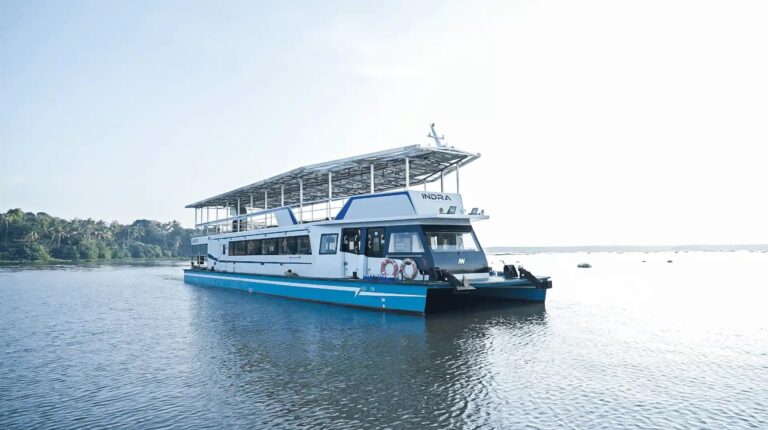
The government of India has approved support for the development and demonstration of a 20-passenger electric boat under the Indo-Canada Collaborative Industrial R&D Programme, through an agreement between India’s Technology Development Board (TDB) and Goa-based Vijai Marine Services Pvt Ltd (VMSPL).
The project, ‘the Smart Sea Project by VACE’, is being supported by the TDB under the Department of Science & Technology (DST), in partnership with Canada’s National Research Council (NRC) and Global Affairs Canada. The program supports joint industrial R&D leading to market-ready technologies.
Under the project, VMSPL will design and construct a high-strength, low-weight fiber-reinforced plastic (FRP) vessel compliant with Indian Register of Shipping (IRS) standards. The vessel will be integrated with electric outboard motors, battery systems and a digital console interface developed by Canadian electric propulsion specialist ACEL Power.
According to the DST, the project will contribute to cleaner inland and coastal water transportation, with applications in water taxi services, river-based passenger movement and tourism-linked operations. The electric boat is expected to offer reduced emissions, lower noise levels and improved operational efficiency compared with conventional diesel vessels. The initiative will also serve as a technology platform for electric marine propulsion systems optimized for Indian operating conditions, particularly in feeder services and environmentally sensitive waterways.
Speaking on the agreement, Rajesh Kumar Pathak, secretary of the Technology Development Board, said, “Through the Indo-Canada Collaborative R&D Programme, the government of India is encouraging industry-oriented research that translates into deployable technologies. This project supports green waterways, promotes innovation in marine engineering and strengthens domestic capability in advanced mobility technologies.”
VMSPL, which operates Vijai Marine Shipyards, is an ISO 9001:2008-certified shipyard with experience in the design, construction and commissioning of marine craft. The company said the TDB backing would help accelerate the commercial deployment of electric boats tailored to Indian use cases.
VMPSL representatives stated that the project would support “the deployment of commercially viable electric boats designed for Indian operating conditions,” adding that it would contribute to “safer, cleaner and more efficient water transport”.
Key technical elements of the project include the use of carbon-fiber-reinforced plastics (CFRP) and vacuum-infusion construction techniques, aimed at improving vessel durability and performance. The project also seeks to demonstrate that electric propulsion can deliver endurance and reliability comparable to diesel systems in real-world operating conditions.
In related news, Western Australia awards contract for manufacture of the state’s first electric ferry fleet